


What Amazon Sellers Must Know to Avoid Blocked Listings
Selling on Amazon gives you access to millions of customers across Europe, the UK, and beyond. But that reach comes with strict rules - and Amazon enforces them aggressively.
Every year, thousands of sellers face blocked listings, suppressed ASINs, frozen FBA shipments, or account warnings. In most cases, the issue is not the product itself, but a misunderstanding of Amazon seller rules and regulations - especially around documentation and user manuals.
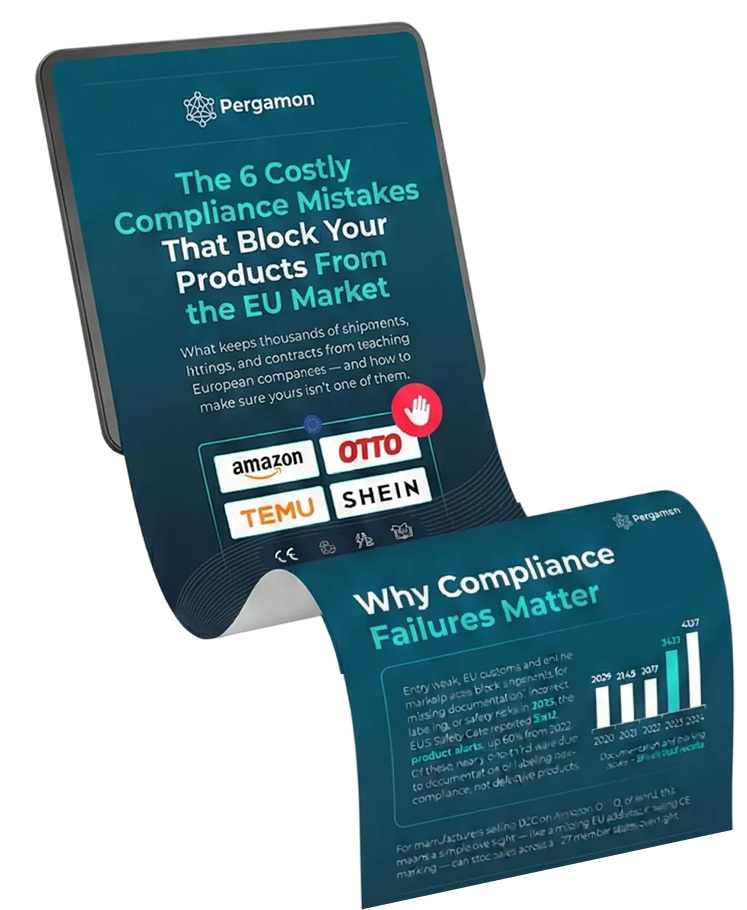
6 Compliance Mistakes
That Block Your Products
Wnat to learn more about Amazon's seller rules and regulations?
Download our full guide to learn how to avoid the 6 most common costly compliance mistakes that block products from the EU market.
Why Amazon Rules and Regulations Matter
Amazon is not just a marketplace. It is legally required to ensure that unsafe or improperly documented products are not sold to consumers.
That’s why Amazon enforces several layers of rules at the same time:
- Amazon seller rules and regulations
These are Amazon’s own platform rules, enforced through Seller Central.
In practice, this is why a product can be listed successfully and later reviewed again. Sellers often see this when Amazon requests documentation months after launch, even if the product has good sales and no negative reviews. - Country-specific government regulations (EU, UK, US, etc.)
Amazon must apply local laws for each marketplace where you sell.
This is why a product can stay live in the UK but be suppressed in Germany: the same manual may be acceptable in English for the UK, but blocked in Germany because no German-language version exists. - Platform-level regulation checks
Amazon performs internal checks to confirm documentation is complete and consistent.
For example, Amazon may cross-check your listing, images, and manual and flag the ASIN if the voltage, model number, or intended use does not match across documents.
If your product fails one of these checks, Amazon may:
- Suppress or remove listings
This often happens suddenly, such as when Amazon cannot verify a requested manual or safety document. - Request documents within 48–72 hours
Sellers frequently struggle here if manuals are stored with suppliers or only exist as generic factory PDFs. - Block FBA shipments
This usually occurs when documentation issues are discovered after inventory has already been prepared for inbound shipment. - Suspend selling privileges
This is less common, but can happen if repeated requests are ignored or inconsistencies remain unresolved.
In most cases, these actions happen without warning - not because Amazon changed the rules, but because a documentation gap surfaced during review.
Amazon Seller Rules and Regulations Explained
Amazon seller rules and regulations are not a single rulebook. They combine three overlapping layers, all of which Amazon enforces at the same time.
Understanding these layers explains why listings are sometimes approved, then reviewed again weeks or months later.
- Amazon platform rules
These are Amazon’s own internal rules, enforced through Seller Central. They define how products must be listed, how brands are represented, and what documentation Amazon can request at any time.
In practice, this is why a product can pass initial listing checks and still be reviewed later. For example, a listing may go live with no issues, then be flagged months later when Amazon requests a user manual or proof of brand ownership during a routine audit. - Local government regulations (EU, UK, US, etc.)
Amazon is legally required to apply local laws in every country where it operates. These rules are not optional, and they vary by market.
This is why the same product can behave differently across marketplaces. A product may remain live in the UK with English documentation, but be suppressed in Germany or France because the manual is not available in the local language or lacks required safety wording. - Product-category-specific requirements
Some product categories trigger additional scrutiny. Electronics, household appliances, children’s products, and personal care items are reviewed more strictly than low-risk goods.
Sellers often encounter this when Amazon suddenly requests category-specific documentation - such as safety instructions or warnings - even though similar-looking products appear to remain untouched. The difference is usually category classification, not seller performance.
Amazon enforces all three layers primarily through documentation requests in Seller Central. When reviewers cannot quickly verify required information - whether due to missing manuals, unclear responsibility, or inconsistent product data - Amazon may suppress the listing until the issue is resolved.
This layered enforcement model is why Amazon actions can feel unpredictable to sellers, even though the underlying rules are consistent.
Core Rules to Sell on Amazon
To sell physical products on Amazon, you must be able to provide certain information on demand, not just at the time of listing. These requirements apply whether you sell via FBA or FBM, and Amazon may request proof at any point during a product’s lifecycle - including long after the listing has gone live.
Amazon reviewers use these rules to verify that the product customers receive matches what is advertised, that responsibility is clearly defined, and that required safety information is available in the right form and language.
To sell physical products on Amazon, you must be able to provide:
- Accurate product descriptions
- Clear brand and manufacturer information
- Required product documentation
- User manuals where applicable
- Safety warnings and labels
- Correct language versions for target markets
In practice, problems arise when even one of these elements cannot be verified quickly. For example, a product description may state a specific voltage, material, or usage scenario that does not fully align with what appears in the manual or on the label. Similarly, sellers often run into trouble when the brand shown in Seller Central does not exactly match the brand named in the user manual or factory documentation.
Another common issue appears during market expansion. A seller may reuse the same documentation that worked for one marketplace, only to discover that Amazon requires additional language versions or country-specific safety wording before allowing the product to stay live elsewhere.
Amazon Government Regulations: What Amazon Enforces
Amazon enforces government regulations on behalf of authorities.
For EU and UK sellers, this often includes:
- Product safety information
- User manuals as safety documents
- Language requirements
- Traceable manufacturer or brand owner details
- Environmental responsibility information
If Amazon cannot verify this information, it must act - even if the product has been selling for months. This means taking down your product even if they are your top selling product!
The Most Common Amazon Regulation Failures
There are too many examples where failing to follow Amazon regulations lead to selling headaches. Below are a few most common examples for you to take note and avoid.
1. Missing or Incomplete User Manuals
Many sellers underestimate manuals. For Amazon, manuals are treated as part of the product itself, not optional extras or post-sale support material. If Amazon cannot verify that customers will receive clear, product-specific instructions, the listing is considered incomplete.
Listings are often blocked because manuals are:
- Missing entirely
- Written only in English
- Copied from similar products
- Missing safety instructions
- Inconsistent with the product model
These issues typically surface when Amazon reviews documentation after a listing is already live. For example, a seller may upload a generic factory PDF that covers several similar models, only for Amazon to suppress the ASIN because the instructions do not clearly match the exact product being sold. In other cases, the manual exists but is only available in English, which may be acceptable for one marketplace but immediately blocks the same product in EU countries with local language requirements.
Another common trigger is missing or vague safety information. A manual that explains basic operation but omits warnings, limitations of use, or maintenance guidance can be flagged during review, even if the product itself has been selling without complaints.
This is one of the most frequent reasons for suppressed ASINs in regulated categories, and it often surprises sellers because the problem lies in documentation quality and specificity - not in the physical product.
2. Wrong Languages for Target Markets
Amazon enforces local language rules strictly, especially across EU marketplaces. These rules come from national consumer protection laws, and Amazon applies them automatically during reviews.
If you sell in Germany, France, Spain, or Italy, Amazon expects:
- Manuals in the official language(s)
- Correct safety terminology
- Localised instructions, not generic translations
Problems often appear during market expansion. A seller may launch successfully on Amazon UK using an English manual, then copy the same listing to Germany. Within days, the German ASIN was suppressed because no German-language manual was available. The UK listing remains live, which makes the enforcement feel inconsistent - but it’s simply Amazon applying local rules.
Even when translations exist, wording matters. Sellers have seen listings blocked because safety warnings were machine-translated and used incorrect terms - for example, using a general word for “warning” instead of the legally required safety terminology in French or German. In those cases, Amazon keeps the listing offline until a corrected manual is uploaded.
Because of this, English-only or poorly localised documentation is one of the fastest ways to trigger Amazon listing removal in the EU.
How Sellers Fix Product Manual Translations With Pergamon
👉 Learn more about Pergamon’s translation workflow:
3. Missing Brand or Manufacturer Accountability
Amazon requires clear responsibility for every product it sells. The platform must be able to identify who is legally responsible for the product if issues arise.
Problems occur when:
- The brand owner is unclear
- Documentation does not match the registered brand
- No EU or UK contact details are available where required
These issues are especially common with private-label and imported products. For example, a seller may register a brand in Seller Central, but continue using a factory-supplied manual that lists the OEM company instead. When Amazon cross-checks the listing against the manual, the mismatch triggers a documentation request and may lead to listing suppression until responsibility is clarified.
Another frequent scenario occurs when sellers expand into the EU or UK without updating documentation. A product that sold without issue in one market may be flagged because the manual or label does not include the required local contact details, even though the product itself has not changed.
4. Inconsistent Product Information
Amazon routinely cross-checks information across multiple sources to confirm that the product being sold is exactly the product described. Amazon cross-checks information across:
- Product listings
- Images
- Manuals
- Labels
- Uploaded documents
Issues arise when even small details do not align. This often includes mismatched model numbers, voltage ranges, dimensions, or intended use. For example, a listing may describe a product as a “220–240V EU version,” while the user manual still references a 110V configuration used for another market. Even if the physical product is correct, the inconsistency alone is enough to trigger a review.
Amazon does not try to determine which version is “right.” If reviewers cannot quickly verify consistency across all materials, the listing is typically suppressed until the discrepancy is resolved and updated documentation is provided.
6 Compliance Mistakes
That Block Your Products
Wnat to learn more about Amazon's seller rules and regulations?
Download our full guide to learn how to avoid the 6 most common costly compliance mistakes that block products from the EU market.
Why Generic AI Tools Often Fail Amazon Reviews
Some sellers try to fix Amazon regulation issues using generic AI tools like ChatGPT or Claude. While these tools can produce fluent text, they are not designed for marketplace reviews - and that gap often creates new problems instead of resolving the original one.
This usually happens because:
- Generic AI tools don’t understand product categories
They lack awareness of category-specific expectations. For example, an electrical product manual generated by a generic AI may miss safety sections that Amazon reviewers expect to see for that category. - They may invent or omit required information
AI-generated manuals can add plausible-sounding warnings that were never tested or remove sections that feel “unnecessary,” even though Amazon expects them to be present. - They don’t structure manuals consistently
Amazon reviewers look for familiar sections in predictable places. When content is reorganised creatively, reviewers may not be able to quickly verify required information. - They don’t track changes or versions
Sellers often upload revised manuals without knowing what changed. When Amazon compares documents across reviews, inconsistencies can trigger repeated suppression.
In practice, this means a manual can be read professionally and still fail review. Sellers frequently see listings remain blocked simply because reviewers cannot quickly locate required sections - such as safety warnings or disposal instructions - even though the information exists somewhere in the text.
How Sellers Fix Amazon Issues Faster With Pergamon
Many sellers only discover documentation problems after Amazon blocks a listing.
Pergamon is designed to prevent that. Pergamon is a purpose-built platform for creating market-ready product user manuals - not a generic documentation tool.
You can see how it works in the short walkthrough below.
👉 Learn more about Pergamon’s manual workflow:
Preparing for Amazon Reviews Before You List
Before listing or updating products on Amazon, check:
- Do you have a complete user manual per product model?
- Does it match the listing exactly?
- Are safety instructions clear and product-specific?
- Are manuals available in required languages?
- Is brand and contact information consistent everywhere?
Addressing these points early prevents last-minute document requests.
Why Amazon Rules Becomes Hard at Scale
Fixing one blocked ASIN is usually manageable. A seller can upload a missing manual, correct a label, or respond to a document request and move on. The problem starts when those same requirements multiply.
Fixing issues across:
- Multiple SKUs
- Across multiple EU markets
- With multiple language versions
quickly becomes overwhelming without a system.
This is where many sellers struggle. One small update - such as correcting a safety warning or updating a brand address - must be reflected across dozens of manuals, listings, and language versions. If even one document is missed, Amazon may flag a different ASIN later for the same underlying issue.
A common scenario is a seller expanding from one or two products to a larger catalogue. What worked when managing a handful of PDFs becomes unmanageable when each SKU has several language versions and each marketplace applies slightly different checks. Sellers then find themselves fixing the same problem repeatedly, ASIN by ASIN, instead of resolving it once.
How Pergamon helps
Amazon rules are rigid. One missing document can suppress a top-selling ASIN overnight.
Pergamon is the first AI-powered CCMS that puts structure and EU market requirements on autopilot- so you avoid the "suppressed listing" nightmare.
For brands, it turns a risky regulatory gap into a 30-minute path from product data to market-ready PDF. It provides the enterprise infrastructure you need to scale your catalog across Germany, France, and Spain without scaling your headcount.
Need a head start? Think of it as Autopilot for user manuals. Start a 7-day free trial and get your products Amazon-ready today.