

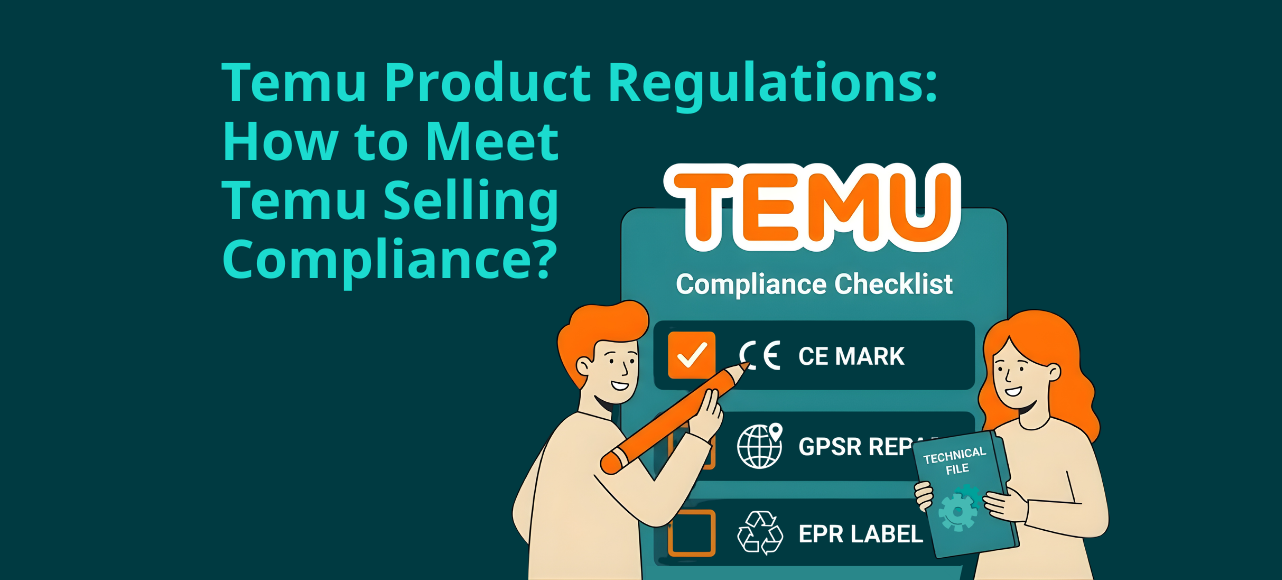

Temu Product Regulation Guide for Sellers
If Temu is rejecting your products, this is no longer an edge case - it’s becoming normal.
Over the past year, more sellers have seen products rejected during Temu onboarding, after listings go live, or following sudden document requests with short deadlines. In many cases, sellers receive only a vague notice such as “documentation incomplete” or “manual requirements not met”, with little guidance on what to fix.
What’s driving this change is simple: Temu is under growing pressure from EU authorities. Like Amazon and OTTO before it, Temu is now expected to prevent unsafe or improperly documented products from reaching European consumers.
As a result, Temu applies stricter checks on:
- product documentation
- safety information
- user manuals
- language coverage
- brand and manufacturer details
For sellers targeting EU customers, documentation issues - especially user manuals - are now one of the fastest ways to get blocked.
Why Temu Rejects Products
Temu is no longer “just a marketplace.” Like Amazon and OTTO, it is now expected to act as a gatekeeper for unsafe or improperly documented products.
In practice, this means Temu actively reviews listings for:
- missing or incorrect product documentation
- incomplete user manuals
- wrong languages for EU markets
- missing manufacturer or EU contact details
- inconsistent product information
If any of these elements are missing or unclear, Temu may reject the product before it goes live, remove it after publication, or request documents with a very short deadline.
This often catches sellers off guard. For example, a seller may upload a small kitchen appliance that passes initial price and image checks and goes live without issue. Weeks later, Temu requests the user manual. The seller submits the English-only PDF provided by the factory - only to see the listing removed within 48 hours because the manual is not available in the required EU language.
From the seller’s side, this usually appears as Temu rejected products with limited explanation, even though the trigger is almost always a documentation issue rather than the product itself.
Temu Product Regulation: What Sellers Must Understand
Temu product regulation is not a separate law. It is Temu enforcing existing EU product rules at platform level.
If you sell to EU customers through Temu, your product must meet the same expectations as if you sold it in a physical EU store.
That includes:
- Product safety information
- Clear instructions for use
- Correct warnings and symbols
- Manuals in the correct languages
- Traceable manufacturer or brand owner details
A product without proper documentation is treated as incomplete. For example, two identical LED lamps are sold on Temu. One includes a multilingual user manual with safety instructions and brand details. The other includes only a QR code linking to a generic English instruction page. The second product is flagged and rejected, even though the hardware is the same.
From OEM to OBM:
The EU Compliance Guide
Want to learn more about why Temu is rejecting your products? Read our essential guide of manual compliance for brands importing from China to the EU.

The Most Common Temu Product Regulation Issues
User manuals are a frequent reason for Temu rejection. If Temu cannot verify that customers will receive clear instructions, the product is likely to be rejected.
1. Missing or Weak User Manuals
User manuals are a frequent reason for Temu rejection. Common problems include:
- No manual provided at all
- Manual written only in English
- Copy-pasted instructions that don’t match the product
- Missing safety warnings
- No brand or model identification
For EU sales, manuals are considered safety documents, not marketing material.
For example, A seller uploads a power adapter with a one-page “Quick Start Guide” reused across multiple models. The guide mentions a different voltage range than the actual product. Temu flags the mismatch and rejects the listing until a correct, model-specific manual is provided.
2. Wrong Languages for EU Markets
Selling in Europe means language matters. Temu checks whether:
- Manuals are available in the language of each target country
- Safety warnings are translated correctly
- The language matches the listing country
English-only documentation is one of the fastest ways to trigger Temu rejected products for EU listings.
If a seller lists a children’s night light for Germany and France, and the manual is provided in English and Spanish, Temu will allow the Spanish listing but reject the German and French versions because the instructions are not available in German and French.
3. Missing Manufacturer or Brand Information
Temu regulations require clear accountability. From Temu’s perspective, unclear responsibility equals risk. If a private-label seller uploads a manual that still shows the factory’s internal company name, while the Temu listing uses a different brand. Temu will flag the inconsistency and request clarification of who is responsible for the product in the EU.
Listings may be rejected if:
- The brand owner is unclear
- No EU contact address is provided where required
- Manuals or labels do not identify the responsible company
4. Inconsistent Product Information (The "Data Mismatch" Trap)
This rejection is usually caused by a simple internal disconnect: Marketing updates the listing, but the manual stays outdated.
For example, if your listing photos show a new "V2" model, but the attached PDF manual still shows the old "V1" diagram, Temu flags it immediately.
To the system, this isn't a typo - it looks like you are shipping a different (or counterfeit) product than what you advertised.
Common triggers:
- Voltage Mismatch: Listing says 220V (EU), manual says 110V (US).
- Visual Mismatch: The safety diagram doesn't look exactly like the product in your gallery.
If the data doesn't align perfectly across every touchpoint, Temu assumes the product is risky and blocks the listing.
The result? The listing is paused until the data matches perfectly.
From OEM to OBM:
The EU Compliance Guide
Want to learn more about why Temu is rejecting your products? Read our essential guide of manual compliance for brands importing from China to the EU.
Why Generic AI Tools Often Make Temu Problems Worse
Some sellers try to fix Temu regulation issues by generating manuals with generic AI tools like ChatGPT or Claude. This often backfires. Why?
- Generic AI tools do not understand product categories
- They may invent or omit safety information
- They do not structure manuals according to product instruction standards
- They do not track versions or updates
A manual that sounds fine can still be rejected by Temu if required sections are missing. This leads to lost time and frustration if this persists.
If a seller uses a generic AI tool to rewrite a manual after a Temu rejection, the new version looks polished but omits disposal instructions and warning symbols. Temu rejects it again - costing another week.
How Sellers Fix Temu Rejections Faster With Pergamon
Unlike generic AI tools or traditional documentation systems, Pergamon is built specifically for creating market-ready product user manuals for companies selling products under their own brand into the EU market.
You can see how this works in practice in the short product walkthrough below.
Watch: How a Coffee Machine Brand Created a Market-Ready User Manual
How to Reduce Temu Rejection Risk Before Listing
Before uploading a product to Temu, check the following:
- Do you have a complete user manual?
- Does it match the exact product model?
- Are safety instructions clear and product-specific?
- Is the manual available in required EU languages?
- Is brand and contact information consistent everywhere?
Catching these issues early saves weeks of back-and-forth with platform support.
How Pergamon helps
Temu demands perfection, but manual updates are slow. Pergamon changes that.
Pergamon is the first AI-powered CCMS that automates product manual creation. We put structure and EU market requirements on autopilot - so you avoid the "data mismatches" that get listings blocked.
For brands, it turns a complex regulatory process into a 30-minute path from product data to market-ready PDF. It gives you enterprise infrastructure that allows you to scale documentation without scaling your headcount.
Need a head start? Think of it as Autopilot for user manuals. Start a 7-day free trial and get your products Temu-ready today.