


For sellers targeting Europe, Temu is one of the most unforgiving marketplaces when it comes to product rules and documentation. Products don’t just get rejected - they disappear, often without much warning.
If you’re asking:
- Can you sell on Temu?
- How do I become a seller on Temu?
- Why do Temu listings get removed so fast in Europe?
This guide explains how selling on Temu works, where sellers most often fail, and why product manuals and documentation standards are a major hidden risk - especially for companies selling products under their own brand into the EU market.
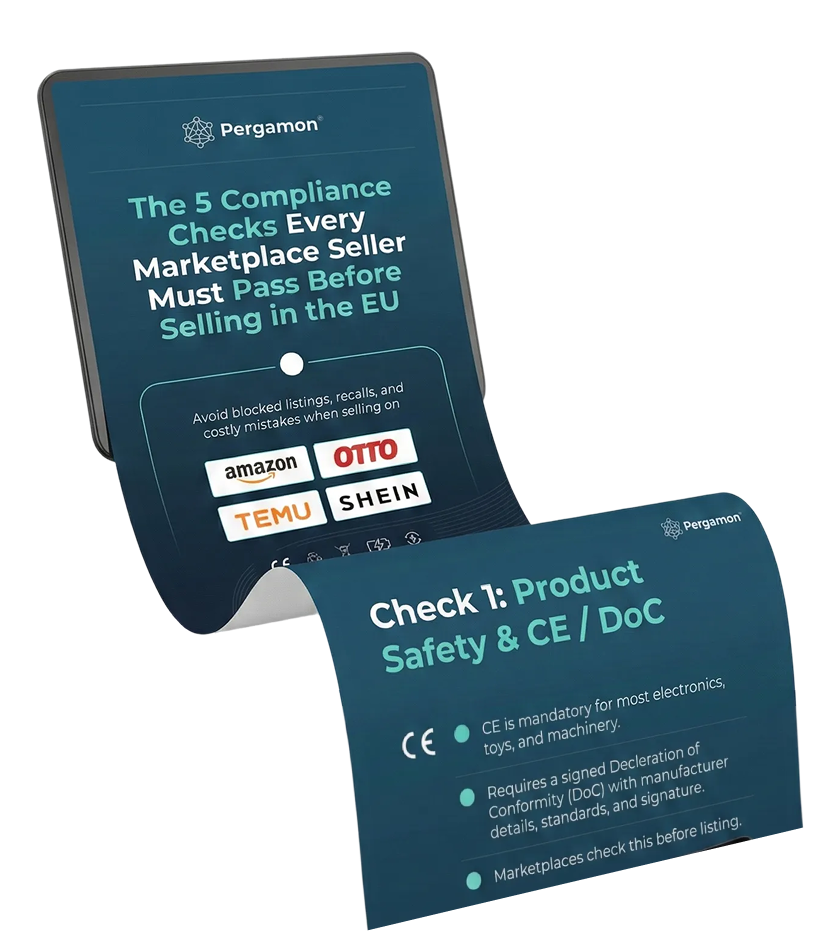
The 5 Compliance Checks
for Selling in EU
Before a product is allowed to stay live on marketplaces like Temu, Amazon, or OTTO, it goes through a small set of documentation checks. This short guide breaks down the five checks that most often lead to blocked listings in the EU.
What Temu really expects from sellers
Temu operates very differently from Amazon, using a highly centralised marketplace model where pricing, promotions, and even product visibility are largely controlled by the platform rather than individual sellers.
Temu tightly controls:
- Pricing
- Logistics
- Product presentation
But Temu does not take responsibility for your product documentation.
If your product documentation is unclear, incomplete, or inconsistent, Temu will usually:
- Pause the listing
- Remove the product
- Or silently stop distribution
This often happens without detailed feedback. For example, a product may appear live but stop receiving orders after an internal review flags missing manuals or unclear responsibility. In these cases, appeals are limited, and sellers rarely receive a detailed explanation of what failed.
On Temu, speed matters more than argumentation. Sellers who can quickly supply clear, complete documentation are far more likely to get products reinstated than those trying to debate decisions after the fact.
Step-by-step: How to become a Temu seller
The process of becoming a Temu seller is straightforward. Below are the steps of registering a selling account in Temu, and items to take note of during the selling process.
1) Apply through Temu Seller Center
Temu onboarding is invite- and approval-driven in many categories. You submit:
- Business details
- Seller information
- Product categories you want to sell

Approval depends heavily on what Temu wants to onboard, not just your interest.
2) Pass seller verification
Temu verifies:
- Legal entity details
- Contact information
- Your ability to supply at scale
Any mismatch between documents slows or stops onboarding.
What sellers miss here:
Temu already assumes you will be able to provide EU-ready product information later. This assumption becomes a problem very quickly.
Step-by-step: Adding products on Temu (where problems start)
Adding products on Temu may look straightforward at first, but this is where many sellers begin to run into issues. Even small inconsistencies, such as missing measurements, unclear material descriptions, or non-standard manuals, can lead to repeated rejections or delays.
1) Create the product listing
You add:
- Product name and category
- Variants
- Core attributes
Category choice matters more than most sellers realize. The wrong category can trigger additional manual and safety requirements later.
2) Upload images and descriptions
Temu prioritizes speed and conversion. But sellers often oversell:
- Features
- Use cases
- Safety claims
If your listing text doesn’t match your manual later, Temu flags it.
3) Submit product details for review
This is where many EU sellers get stuck. Up to this point, Temu onboarding can feel fast and frictionless. The review stage is different. This is where Temu shifts from commercial checks to risk and documentation checks, especially for products sold to European customers.
At this stage, Temu may request:
- Product instructions
- Safety information
- Clarifications on use, materials, or warnings
These requests often come after the product data has already been entered, which is why sellers are caught off guard. Temu is not asking for marketing copy - it is checking whether customers will receive clear, product-specific instructions and safety information.
This is where product manuals become a major failure point. A common scenario is a seller submitting a factory-supplied manual that looks acceptable at first glance, but is generic, incomplete, or only available in English. Temu may then ask follow-up questions about safe use, intended users, or materials - or pause the review entirely until clearer documentation is provided.
Another frequent issue is mismatch. For example, the product listing may describe one use case, while the manual describes another, or the manual may omit warnings that are implied by the product category. Even small gaps can trigger delays, because Temu’s reviewers need to quickly verify that instructions, warnings, and product details all align.
Temu product manual standards: where sellers fail most
For many consumer products sold into the EU, instructions for use are mandatory. Temu enforces this strictly because clear instructions reduce safety complaints, returns, and platform liability. From Temu’s perspective, a product without proper instructions is not “unfinished paperwork” - it is an incomplete product.
Common Temu manual problems include:
- No manual provided at all
- English-only manuals for EU sales
- Manuals copied from other products or suppliers
- Missing safety warnings
- Instructions that don’t match the actual product
These issues surface frequently during onboarding or post-listing reviews. For example, a seller may upload a factory manual that looks professional but is reused across multiple models. Temu reviewers then find references to features or usage scenarios that don’t apply to the listed product, which is enough to flag the documentation as unreliable. In other cases, the manual exists but is only available in English, even though the product is being distributed across several EU countries.
From Temu’s perspective, this creates immediate risk. If customers cannot access clear, product-specific instructions in the correct language, Temu cannot justify keeping the product live.
From the seller’s perspective, it often shows up as:
- A sudden product takedown
- A request for documents with short deadlines
- No clear explanation of what exactly is wrong
A common frustration is that the product itself may be perfectly safe and already selling without complaints. However, Temu does not assess safety by usage history. If the manual is missing, incorrect, or inconsistent with the product listing, that alone is enough to stop sales until the issue is resolved.
This is why manuals are one of the most frequent - and least expected - failure points for Temu sellers targeting the EU.
Language rules make it worse
Europe is not one market. If Temu ships your product to:
- Germany → German instructions are expected
- France → French instructions are expected
- Spain → Spanish instructions are expected
Temu does not accept:
- “EU English” manuals
- Rough machine translations
- One generic PDF for all countries
Poor translations - especially in safety sections - are a common reason products fail Temu’s internal reviews.
A common scenario is a seller listing the same household product across multiple EU countries using a single English manual labeled as “EU version.” The product goes live initially, but during an internal review Temu flags the documentation. The German and French distributions are paused because no German or French instructions are provided, even though the listing itself looks correct.
In other cases, sellers submit machine-translated manuals to meet language requirements quickly. Temu reviewers then identify incorrect or vague safety wording — for example, warnings that are translated literally but lose their legal meaning. When that happens, Temu treats the manual as unreliable and stops distribution until a corrected version is uploaded.
The biggest Temu myth: “They’ll tell me what’s wrong”
They often won’t. Temu’s priority is speed and platform protection. If something looks risky:
- The product is removed
- Distribution stops
- Sellers are left to guess what to fix
This is why sellers with ad-hoc manuals and scattered files struggle the most.
The 5 Compliance Checks
for Selling in EU
Before a product is allowed to stay live on marketplaces like Temu, Amazon, or OTTO, it goes through a small set of documentation checks. This short guide breaks down the five checks that most often lead to blocked listings in the EU.
How Pergamon helps
Temu demands speed and precision. Pergamon delivers both.
Pergamon is the first AI-powered CCMS that automates product manual creation. We put structure and EU market requirements on autopilot-so you avoid the "silent takedowns" that affects Temu sellers.
For brands, it turns a risky regulatory gap into a 30-minute path from product data to market-ready PDF. It gives you enterprise infrastructure that allows you to scale documentation without scaling your headcount.
This means fewer Temu takedowns, faster responses to platform requests, and documentation that scales with your catalogue.
Need a head start?
You can start a 7-day free trial. Selling on Temu can work in Europe. But only if your documentation is as strict as the platform itself.